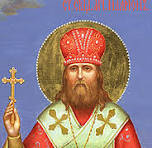
Excerpts from the essay “Christianity and the Church,” by New Martyr St. Hilarion Troitsky
The basis of Church unity does not consist of legal principles, which guard personal egoism, but love, which is the opposite of personal egoism. In His parting conversation, Christ said to His disciples: “A new commandment I give unto you. That ye love one another; as I have loved you, that ye also love one another. By this shall all men know that ye are My disciples, if ye have love one to another” (John 13:34-35).
But how is it possible to implement such a unity of people in a Church community? The natural state of man corresponds more to the creation of a merely legal society, for sin is the self-assertion and self-love which is guarded by civil law…
Such an implementation is, however, made possible by the concept of the Church. Christ gave the commandment to love one another, but the commandment alone is insufficient. Like every theoretical proposition, it can create nothing if the power for the fulfillment is not provided. If Christianity limited itself to the theoretical teaching of love, it would be of no use because the power for the realization of this teaching is not available in human nature, which is distorted by sin. Reason confesses that this commandment about love is good, but man constantly meets a different law within himself which struggles against the law of the mind and which makes him captive to the sinful law (Rom. 7:22-23). The work of Christ, however, is not limited to theoretical propositions and it is in this that the strength and significance of His work rests.
…According to the teaching of the Apostle, all [Orthodox]Church life is a manifestation of God’s Holy Spirit; each manifestation of love, each virtue is the action of a gift of the Spirit. According to the words of the Apostle Peter, people are but “stewards of the manifold grace of God” (1Pet. 4:10). The Spirit of God has, by its own power, penetrated the entire body of the Church and given various spiritual gifts to each of its members, making possible a new life for mankind. It unites all into one body, unifying in such a way as to instill a kind of love in the hearts of men which, in their natural state, cannot be a principle of their lives and relationships with other people.
…Love is of God - this dictum of the Apostle John can be termed as the general theme of a whole series of apostolic discourses. Love is given the title “of God.” The love of Christ constrains the members of the Church (2 Cor. 5:14). Love is the fruit of the Spirit (Gal. 5:22). God’s love is poured out into our hearts by the Holy Spirit which is given to us (Rom.5:5).
…Thus, the Holy Spirit which dwells in the Church gives each member of the Church strength to become a new creature whose life is guided by love.The teaching of the Apostle Paul concerning the Church is inseparably linked with his teaching of love as the fundamental principle of Christian life. This connection is little noticed by contemporary scholarly commentators, but the Holy Fathers of the Church point it out. Concerning this apostolic comparison of the Church with the body, Blessed Theodoret says, “this comparison is appropriate in the teaching of love.” St. John Chrysostom, interpreting the words, “a single body” says, “Paul demands from us a love that would bind us together, making us inseparable one from another, and of such complete unity that we seem to be members of one body. Only such a love as this produces great good.”
In reading the epistles of the Apostle Paul, one may note that he usually speaks about the Church and about love side by side. This, of course is because both of these ideas are inseparably linked together in the very system of the Apostle. All of his Christian ethics are based upon the dogmatic teaching about the Church. Thus, In the first Epistle to the Corinthians, after the teaching about the Church in the twelfth chapter, the “New Testament Song of Love” directly follows (12:31-13:13). Something similar to this can also be noted in the epistles to the Ephesians and the Colossians…
What follows from all that has been said? The teaching of Christ is a teaching not only about the re-creation of a separate moral person, but also about the re-creation of a perfect society, i.e., about the Church. God’s Spirit, living in the Church, gives strength for the realization of Christian teaching in life. Since this teaching is a teaching about love, then its realization again creates a community because love is a foundation which binds and does not divide.
…All the growth of the entire Church organism depends on each separate member sacredly observing the law of love. The perception of the gift of the Spirit is possible only through love and in union with the Church.
Add comment
Comments