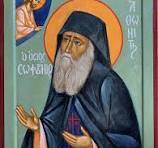
The Divine Liturgy…helps us to enter into the whole tragedy of humanity and to pray for people’s suffering. We live Christ’s prayer in Gethsemane and His Crucifixion on Golgotha. The Divine Liturgy helps us to penetrate into the whole of humankind and to pray for the departed and for sinners. The ‘spirit’ of the Divine Liturgy is the ‘spirit’of sacrificial love, the depth of Christ’s self-emptying and His prayer in Gethsemane, which we should imitate.
Many theologians talk about deification in the abstract. What is important is to keep Christ’s commandments. In this way we arrive at deification and the Light.
We recognize the visitation of divine grace from contrition, the sense of repentance, and weeping. Joy comes immediately afterwards. The vision of the uncreated Light comes negatively in the beginning, with tears and weeping, the sense of hell, because we see our passions. This is the start of spiritual life.
We should pray continuously, even when walking along the road. We should say “Lord Jesus Christ, save Thy world and me.” We should also say the prayer: “Lord Jesus Chrost, Son of God, have mercy upon me a sinner” for a short time in the morning and a short time in the evening. We should not however specify from the outset how long the time of prayer will last, lest it become a habit. We should pray according to the fervour and appetite that is created, according to our inspiration. Then the time aspect will increase day by day.
When we repeat the Jesus Prayer all our passions will be revealed, because then the devil makes war on us at our weak points in order to distract our nous from prayer. Prayer stirs up a tempest of temptation and attacks form the devil, who attempts to distract our nous from prayer. The thoughts that come during prayer indicate the stronger passions that dominate us. Subsequently we have to struggle and strive for these specific passions to be cured. Above all we should confess them to our spiritual father and seek guidance in order to heal them. In this way prayer uncovers the passions, and repentance according to grace cures them.
We need to teach our nous to attach itself somewhere, to God, to our brethren, to our spiritual work, and not let it wander about as it wants, under the influence and sway of the passions. Then the nous learns to cleave to God and wherever we lead it, but carnal desires also wither way. As a consequence, the body is subjected to the spirit.
Monks are forbidden to cry about matters to do with human life (death, lack of necessities). Tears are good for a monk if he weeps for his sins.
Through humility alone we are saved, and through pride alone we are destroyed.
We understand that tears are not sentimental when they produce a sense of contrition and repentance. When pride and a vain thought come at the same time as the tears, the tears of divine grace cease.
Great care is needed with regard to judging bishops. We do not know exactly the conditions under which they live. It is absolutely certain, on the basis of experience, that we shall be judged for whatever we judge, and we shall fall in the same way.
We Christians become persons when we are united among ourselves in Christ and live one within the other through love. Thus we live according to the Trinity.
Our love for God and our brother is a confession of faith. Consequently, when we love God, we confess Him.
Usually other religions and other systems conceive and construct the idea of God through man. In the Orthodox Church we perceive man through the presence of God, insofar as man is in God’s image and likeness. So correct knowledge of God is a prerequisite for knowing man and for solving his problems.
We shall love other people when we pray for them. In order to understand what bothers someone else, we must pray for him with our heart. Then we see his needs and take care to solve them.
The non-Orthodox live in ignorance. God will judge them accordingly. But for us Orthodox, salvation is deification, that is to say, our union with Christ through His holy commandments and the Mysteries.
Those who do not live evangelically and ascetically all week cannot live liturgically on Sunday.
The greatest missionary work is accomplished through the Divine Liturgy. The Fathers erected an altar in every country or city to which they went. This is because, when the heart melts in the Divine Liturgy, it seeks God and begins to want to live the Orthodox ecclesiastical life, which is centered on the Divine Liturgy.
Westerners have lost Orthodoxy, which shows the way to salvation. Thus some of them rely on reason separated from the heart (rationalism) and others rely on sentiment, separated from the reason (sentimentalism). The nous is united with the heart only by the Holy Spirit, and man becomes in the image and likeness of God.
I believe that the salvation of the world comes about through the Orthodox Church. The Orthodox Church is always crucified, as Christ was, and we are crucified, not crucifiers.
For noetic prayer, ordinary light (from the sun or a lamp) or even the colour of the walls, causes difficulties as does noise. Darkness and quiet are required for practicing noetic prayer. The colours of the room should be dark and the icons not too bright.
When a thought or an unlawful love gets into us, it goes away with weeping. Every kind of evil leaves the soul by means of tears.
When something or someone attracts our love more than love for God, we are committing spiritual adultery.
Even the perfect suffer harm when they hear praise. When a monk surrenders to thinking about the praises other people have addressed to him, he stops being a monk.
An Orthodox monastery does as much missionary work as a parish.
When wealthy people want to donate money and wish to get involved in the life of the monastery, we should not take it, in order to preserve our spiritual freedom. We should tell them to put it anonymously in the collecting box if they want to.
People’s growing love of psychology is a terrible thing. Psychology helps those in the West, but it is dreadful when the Orthodox learn psychology and substitute it for the neptic tradition of the Church. We must undermine Orthodox Christians’ love of psychology, because psychological methodology is outside the Orthodox tradition and, at the same time, it is characterized by the Western mentality.
Usually I do not impose a rule with regard to prostrations; I do not lay down how many prostrations someone should do. Rather, I advise him to make prostrations until he is tired, and until his body becomes accustomed to participate in prayer with his nous. In this way everything is done with love and freedom, without coercion.
One ought not to pay attention to oneself while prayer is active. Sometimes the energy of prayer ceases for various reasons, mostly due to inappropriate actions. Then contrite and penitent prayer is required.
In general, we ought to live with a sense of sinfulness. This develops profound repentance and so prayer is activated. One should not spy on oneself and observe the states of prayer inside oneself.
When a thought produces pride, we should say: “death has fallen upon me. My murderers have come.” This gives rise to repentance.
When someone prays he should pay no attention to anything, even the warmth produced in his heart. He should simply be in a state of profound penitence and feel that he is far from God. He should be like a train that keeps speeding towards its destination.
Tears are essential for prayer and the spiritual life in general. Not many tears are needed, but even a single teardrop with inner mourning of the heart. This mourning is very significant. Contrition is impossible without tears. Tears are a sign that the nous has been united with the heart in the Holy Spirit, and for that reason the Fathers ascribe great importance to tears during prayer.
When someone has nightmares or feels disturbed, he should get out of bed and pray. After weeping the soul is cleansed of these images. A powerful prayer is: “Heal my soul, for I have sinned against Thee.”
Through rational knowledge we learn what the Fathers said about God, but through prayer we learn what God Himself says: we hear God’s own voice.
One should adjust prayer to suit the work that one does. It is possible to lose prayer in the desert and to find it in the city.
Now I realize more than ever that everything outside Christ is a delusion, an absurdity.
There is a great difference between East and West. A Westerner who is baptised Orthodox will spend many years in the Orthodox Church, under the guidance of an experienced spiritual director, in order to acquire a wholly Orthodox mentality and ethos. Until then he cannot, and should not, act as a teacher to people who are of Orthodox stock, who were born and brought up as Orthodox.
..The union of the Churches is difficult or impossible. Those who talk about ‘union of the Churches’ are ignorant of the way non-Orthodox think and of the exalted nature of Orthodoxy.
All those who have been involved in Buddhism must repent completely, because otherwise this eastern experience will leave something in their soul.
I do not want the ‘union of the Churches’ to come about, at least at the present time, because the Roman Catholics will not change, but the Orthodox will be corrupted.
Faith gives birth to fear, not fear to faith, as the fear of God is born of faith in God. The Orthodox experience faith in God, whereas the fear of God is the characteristic feature of Westerners.
Add comment
Comments