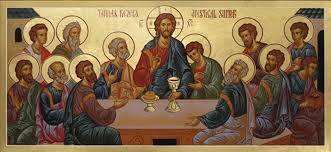
In this farewell discourse, the Lord expresses perfect love for His disciples. They are His regenerated children and through them and upon them Jesus was to establish the foundation of the new world. This perfect love of Christ for His disciples is vividly manifested at the Last Supper by the washing of the feet and the Lord’s self-offering in Holy Communion.
This washing of the feet took place between the two suppers, after the physical meal and before the Mystical. “When the glorious disciples were enlightened at the washing of the feet before the supper…”(Troparion of Great and Holy Thursday). Jesus’ washing of the disciples’ feet represented the inner, spiritual cleanliness of those who were prepared to eat the food of eternal life. By this time, the disciples were already bathed in the word and power of His Spirit. The disciples were wholly clean, having been cleansed both inwardly and outwardly. He declared all the disciples pure, except the betrayer, Judas. “..ye are clean, but not all of ye.” Moreover, the wash basin expresses the perfect love of Jesus toward His disciples, whom He serves and protects and cleanses and sanctifies. How important it is that we ourselves approach the Communion cup with fear of God, faith and love, that we prepare ourselves with frequent and heartfelt confession, fervent prayer, self-emptying charity and attentiveness to the Liturgy of the Word.
The washing also expresses the profound voluntary humility of Jesus that He might exalt the humble according to His own supreme greatness, and teach them exaltation through humility. Perfect love is manifested through perfect humility. The virtue of humility brings down the only-begotten Son of God from the heights of eternal Divinity to the humble position of the lowest man - the one destitute, the one who had no place to lay His head. Christ’s descent is a willing descent from above, from supreme heights to earth, a unique humility observed only in Him. Jesus lowered Himself into the form of a human servant and became obedient to God until death on the Cross. Such humility is the strength which realizes the most perfect will of the Father. The supreme height of Christ corresponds to His extreme humility, for the more Christ lowered Himself, the more He was exalted. Just as Christ's glory is founded upon His humility, so the glory and the privilege of each man within the Kingdom of God corresponds to his humility. The extent to which one humbles himself determines his height and greatness in the Kingdom of God. Therefore, Christ said to His disciples who contended for first place: “If any man desires to be first, the same shall be last of all, and servant of all.” Manifesting his own humility, Christ said: “Learn from Me, for I am meek and lowly in heart…” After he had washed their feet, He said to them: “Know ye what I have done to you? Ye call me Master and Lord; and ye say well for I am. If I then, your Lord and Master, have washed your feet, ye also ought to wash one another’s feet. For I have given you an example that ye should do as I have done to you.”
The Lord tells His disciples: Ye also ought to wash one another’s feet. Love and take care of one another as I have you; prefer to serve your brethren; prefer the humble position of servant. In this way, Jesus instilled in His disciples the humility of service to others, and the binding love and peaceful fellowship of life together in loving communion with God. We must humble ourselves and wash the feet of our brothers and sisters; we must offer ourselves, give entirely of ourselves, without concern for status or authority. We must have no consideration other than loving our brothers and sisters in the self-emptying way in which the Lord has loved us.
If ye know these things, blessed are ye if ye do them”
Disciples should become servants of their brethren in order to become blessed. Repeated emphasis is made In Holy Scripture and the Fathers on a dynamic and active Christian life. Our faith is lived or it is nothing. This is where our genuine personhood lies, in conducting oneself everywhere and in all circumstances according to God’s will in a communion of love.
In partaking of the Mystical Supper, the disciples became partakers of the Body and Blood of the New Man, who voluntarily sacrificed Himself in order to provide the food toward eternal life. Those purified and sanctified in the liturgical and ascetic life of the Church, who partake of the communion cup and acquire the Gospel virtues, are created anew, are deified and become Christ-like. We have received Him into our hearts but too often, as St. Theophylact writes, “we have cloaked Him with our sins, restricting His ability to act in us.”
The Mystical Supper benefited only the inwardly pure disciples whereas Judas was condemned by his participation in Holy Communion, upon which Satan entered him. Jesus is troubled and we might relate this to how the tainted and impure betrayer unworthily partook of the pure and sacred body of the Lord. The human being made to be the temple of the Holy Spirit becomes the dwelling place of the evil one. This should speak to us in a powerful way, we who dare to eat the pure and sacred body of the Lord.
“That Thou doest, do quickly.”
Judas is cut off and separated from Christ. “...And it was night.” The absence of love leads to darkness. Satan took Judas when Jesus granted permission. Jesus gave Judas food and life and Judas returned betrayal and death. “That thou doest, do quickly." St. John Chrysostom says these words show that the Lord desired to correct Judas, “but that since he was incorrigible, He let him go.” According to Chrysostom, the Lord implied the following: “He spake thus,” - do quickly - “to show that the things were true which had been said by Him to the Jews concerning His death. For He had said to them, “I have power to lay down My life, and I have power to take it again”; and, “No man takes it from Me.” Christ was fully prepared for His sacrifice and was willingly surrendering to the Cross to accomplish the salvation of humanity. St. Cyril of Alexandria emphasizes that Christ was demonstrating His divine control and authority over the situation; Jesus knew what Judas was plotting, but instead of avoiding it, He urged the betrayal forward so that the divine plan for the redemption of the world could be quickly fulfilled.
Sadly, many leaders of our Church today have fallen away from the ethos of Orthodoxy and promote a poisonous, false ecumenism that undermines our self-understanding as the Church. They maintain an ecclesiology that still views papal catholicism as somehow still of the one Church. Some go so far as to encourage Catholics attending the Orthodox liturgy to receive Holy Communion.There are even occasions when it has been suggested that there are many different roads to God, other than through Christ and His Church. Such views contrast sharply with the Fathers of the Church and, when taught and acted upon, amount to a betrayal of Christ and His Church. And yet, they persist in their efforts toward false union. We pray that they be enlightened and the Church be spared this heresy and the division that would ensue. On the other hand, as a dear elder once remarked, the words of our Lord expressed to Judas may apply to them as well “That thou doest, do quickly.” Do it quickly, that the Church may deal with the matter and address this false ecclesiology in a way that witnesses to the truth of our faith, enlightening the faithful and expelling the wolves among us who are hidden in sheep’s clothing. The initial turmoil is regarded by St. Gregory the Theologian as a “blessed confusion” because it leads to a confession of the true faith. As St. Paul says: “There must be heresies among us, so that the faithful may be made manifest.”
“He who receives whomever I send receives Me.” The Lord washed the feet of His disciples to demonstrate their preparation for preaching the Gospel. Foreseeing this, Isaiah prophesied: “How beautiful are the feet of them that preach the Gospel of peace!”(Is.52:7) In their preaching of the Word, they convey to others the purity imparted to them by the teaching of the Master.
Those who accepted the teaching of the Apostles concerning the true Christ, accepted Christ Himself. By receiving the true Christ, they received within themselves God Himself, assuming the divine nature and becoming children of God, even brothers of Christ. Important here is Christ identifying with His faithful. We see this also in the Acts of the Apostles, when Saul is knocked off his horse and the Lord speaks to him the following words. “Saul! Saul! Why do you persecute Me?” The Lord identifies with His Church; He is the Head of the Church; the Lord abides in His faithful servants.
“Now there was leaning on Jesus’ bosom one of the disciples whom Jesus loved.” At the supper, St. John the Evangelist manifests perfect love for Christ. He is for us the perfect example of Christian virtue and holiness. God rests in His saints as the saints rest in God. Here we see the Lord and His beloved disciple resting in each other’s bosom. How moving! The beloved John, through his purity, was strongly drawn to the most pure Jesus and found comfort on His breast. The beloved John is regenerated through the Lord’s everlasting love and transformed by His Divine Grace, becoming Christ-bearing and God-bearing, Christ-like and deified. He would become “a god by grace,” as would all the Apostles. Experiencing perfect love for Christ, John teaches the entire Church of Christ this new commandment of love.
“Now is the Son of man glorified and God is glorified in him;”
These words signify the revelation of the truth through the Cross. He is the Son of God, begotten of the Father, existing before the birth of Abraham and before all ages. The Cross would prove Him true Son of God, and glorify God, proving God to be the Father of a Son co-substantial, only begotten and equal to the Father, as Jesus said and taught. God the Father glorified Him upon the Cross by darkening the sun, shaking the earth and rending the veil. God glorified Him through these great signs, so that the centurion cried out, “Truly, he was the Son of God.” According to Chrysostom, after the supper He would proceed “to a thing of far greater daring, the Cross itself, to the death of shame, and there again he manifested His loving-kindness. And here he calls it “glory,” showing us that there is nothing so shameful and reproachful which makes not brighter him who goes to it, if it be done according to the will of God….And this is what he said of Himself, ‘When I am lifted up, then ye shall know that I Am’; and again, ‘No sign shall be given you but the sign of Jonas.’ ”
“A new commandment, love one another, even as I have loved you, that ye also love one another.”
“By this shall all men know that ye are my disciples, if ye have love one for another.”
The observance of this command is entirely new, and is enjoined by Jesus on His disciples and the new Christian world. Upon the spirit of this command and its observance are founded a new life, a new spiritual society whereby man is molded after the image and likeness of the New Man and becomes a blessed citizen of the eternal kingdom of God. According to Chrysostom, “it is this [Christ-like love] which chiefly shows men holy; it is the foundation of all virtue; by this mostly we are all even saved….And miracles do not so much attract heathen as the mode of life; and nothing so much causes a right life as love.”
Christ the God-Man is new, His commandment is new, His resurrection is new, His life is new. The genuine and true disciples of Christ have, as an essential attribute and distinguishing characteristic, love for one another, as Christ loved His own disciples and all men for whom He died. Without the virtue of humility, even the presence of all the other virtues still does not indicate the true and genuine disciples of Christ.
The true disciples of Christ possess as their distinguishing characteristic the love of Christ, with which are naturally united all the different moral virtues and attributes of the perfect nature of man. St. Paul calls this a perfect union and fulfillment of the law and the greatest of all gifts. The Lord came down from heaven to earth in order to teach this unknown love to men, by word and deed, and to impart this divine love to His disciples through His own Body and Blood, after purging them of selfish and egotistic love. He instilled in their pure hearts the love of His own heart, directing them to act and do good to one another according to the benevolent nature of this divine love, which is the foundation of the holy and blessed life. Only these can govern themselves by this commandment who consistently practice repentance, confession, mourning, tears, baptism and the resolve to sin no more; only they are rid of the inner root of every vice and sin, that is, self-love. Otherwise, it is impossible for people to live according to the Gospel and the new commandment to love others with the love of Christ.
Sadly, Christians today live in an un-Christian manner. Instead of the benevolent love of Christ in their hearts, they have the egotistic self-love and hostility of satan. We profess belief in Christ but engage in anti-Christian works and are much worse than the disbelievers. We are lacking the essential characteristic of Christ’s disciples - self-emptying love toward one another. We must resolutely cultivate a living faith inspired by love such as that possessed by the first Christians. Only through such love can the true and genuine disciples of Christ and the Apostles be known in the midst of the world.
Whither I go, you cannot come. ”Peter says unto him, Lord, why cannot I follow the even now, I will lay down my life for thee.
Peter loves the Master and love cannot bear separation from a loved one but demands fellowship and union. Peter thinks he can die for the beloved Master but has no real knowledge of himself, of his inability, and that he is promising the impossible. Lacking knowledge and trust in the Lord he would do the exact opposite of what he promises. This denial is foretold by the Lord.
Chrysostom says: “...in a short time thrice did he utter the words of denial, that he might learn that he did not so love as he was loved…So that the denial was caused not by the cooling of his love, but from his having been stripped of aid from above.” It is not a lack of love but Peter’s stubborn zealousness and overconfidence that cause him to fall. The Lord’s rebuke is a reminder that without Grace we can do nothing. But after his repentance and the reception of the Spirit, Peter and the other disciples would rise toward heaven by the same way and be glorified together with their own Master.
__________________________________ To be continued.
Add comment
Comments